
Almost every metal product has holes in it. Bolt holes, rivet holes, mounting holes, cooling holes — they hold parts together and make assemblies work. How those holes are made decides how well the final product fits and performs.
For a long time, drilling holes meant marking, clamping, and drilling by hand. It was slow, and accuracy depended on the operator. A small error in hole position could ruin an expensive part.
CNC drilling solved this problem. By letting a computer control the drilling, it produces holes in exactly the right place, at the right size, every single time. It is faster, more accurate, and far more consistent than manual drilling.
Today, CNC drilling is a core process in fabrication, structural steel work, automotive, and heavy engineering. This guide explains what CNC drilling is, how the process works, the types of machines and operations involved, and where it is used — in plain, practical language for manufacturers and buyers.
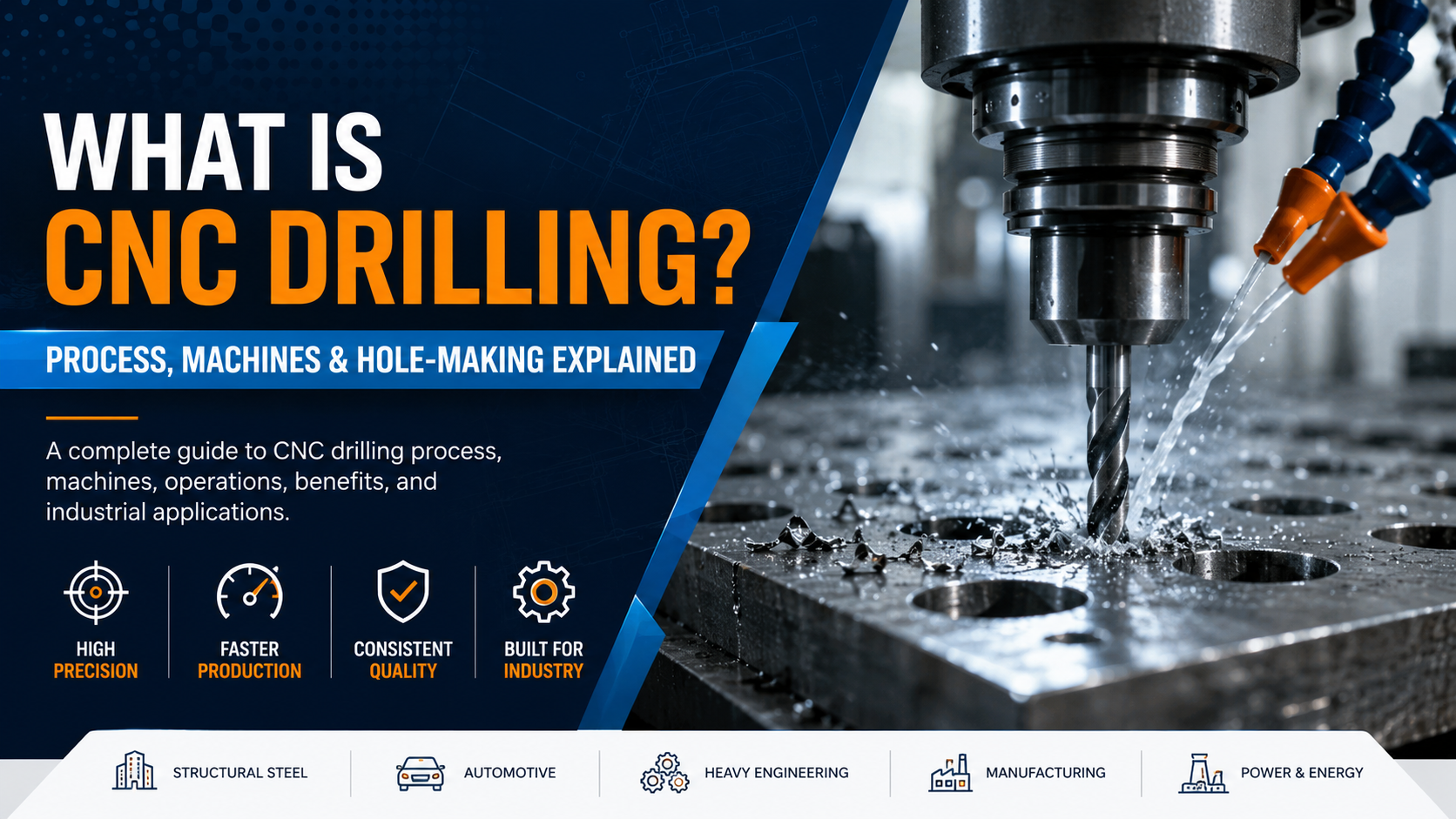
CNC drilling is an automated process that uses a computer-controlled machine to make holes in a workpiece. "CNC" stands for Computer Numerical Control, which means a program guides the drill to the exact position, depth, and size needed.
Instead of an operator positioning the drill by hand, the machine reads a digital program and moves the drill bit and workpiece precisely. The result is accurate, repeatable holes with very little human error.
CNC drilling is used on metal plates, sheets, beams, blocks, and many other parts. It is one of the most common machining processes in manufacturing because nearly every assembled product needs holes. A rotating drill bit is pushed into the material to remove metal and form a hole. What makes it "CNC" is the control:
The CNC drilling process follows clear, repeatable steps. Here is what happens from design to finished part.
Because the program controls everything, the same part can be made again and again with identical results.
Different jobs need different machines. Here are the main types used in industry.
A standard CNC drilling machine is built for accurate, repeatable hole-making in sheets, plates, and general fabricated parts. It is ideal for shops that need consistent holes across many components, with fast positioning and minimal manual work.
A CNC plate drilling machine is designed for drilling holes in thick, heavy steel plates. These machines are common in structural steel, heavy engineering, and infrastructure work, where base plates, flanges, gusset plates, and connection plates need precise holes. Many plate drilling machines use multiple spindles and can also handle operations like tapping and milling, making them highly productive for heavy fabrication.
A CNC tube sheet drilling machine is specially designed for drilling precise holes in tube sheets used in heat exchangers, boilers, condensers, and pressure vessels. These machines ensure high positional accuracy, efficient processing of large plates, and consistent hole quality, making them ideal for industries such as power generation, petrochemicals, and heavy engineering.
Larger setups include beam and gantry drilling systems for very large structural members. The right choice depends on part size, plate thickness, and production volume.
CNC drilling has become essential in modern manufacturing for several clear reasons.
The table below compares CNC drilling with manual drilling across the factors that matter most.
| Factor | CNC Drilling | Manual Drilling |
|---|---|---|
| Accuracy | Very high, programmed | Depends on operator |
| Speed | Fast, automated positioning | Slow, hole by hole |
| Repeatability | Identical every time | Varies between parts |
| Labour Requirement | Low (one operator, many holes) | High |
| Suitability for Volume | Excellent | Poor |
| Automation Capability | High | None |
For any shop producing parts in volume, CNC drilling delivers better quality at a lower cost per part.
CNC drilling machines handle a wide range of materials, with speeds and tooling adjusted for each:
CNC drilling supports almost every metalworking sector. Here is how key industries use it.
Drilling is not the only way to make holes. Here is how it compares with other common methods.
| Method | Best For | Precision | Notes |
|---|---|---|---|
| CNC Drilling | Round holes, tapping, deep holes | Very high | Clean holes, ideal for thick plate and threads |
| Laser Cutting | Holes in thinner sheet, complex shapes | High | Fast for many small holes; limited on very thick plate |
| Punching | High-volume holes in thin sheet | Moderate | Very fast but tool-dependent and noisy |
| Manual Drilling | One-off or repair work | Low–moderate | Cheap but slow and inconsistent |
In practice, many shops use a mix. A CNC laser cutting machine may cut the blank and small holes, while a CNC drilling machine handles precise, deep, or threaded holes — especially in thicker material.
Hole-making rarely stands alone. In a real production line, parts flow through several steps that must work together.
A typical flow looks like this:
When cutting and drilling equipment are well matched, parts move smoothly with less handling and rework. That is why many fabrication and engineering firms plan these machines together.
Yantra Design is a manufacturer and supplier of CNC machines built for Indian manufacturing and engineering industries. CNC drilling is one of our core strengths.
If your work also involves cutting and plate processing, our team can help you plan a setup where every step works together.
CNC drilling is one of the most important processes in modern manufacturing. By letting a computer control hole position, size, and depth, it delivers accuracy, speed, and consistency that manual drilling cannot match. From simple bolt holes to threaded and counterbored features, it covers the hole-making needs of almost every industry.
Whether you produce light fabricated parts or heavy structural plates, the right CNC drilling machine raises quality, cuts waste, and speeds up production. And when your drilling is planned alongside cutting and finishing, the whole line runs more smoothly.
If you are planning or upgrading your hole-making capability, Yantra Design offers precise, reliable CNC drilling and plate drilling solutions. Reach out to discuss the machine best suited to your production needs.
Join the ranks of satisfied clients who have experienced the difference of working with a leader in CNC drilling machine manufacturing.