
In today's fast developing manufacturing industries, CNC drilling machine plays an important role for its accuracy, automation and higher production efficiency. These machines are applied in steel structure industry, automotive manufacturing industry, construction industry, aerospace industry, railway manufacturing industry, heavy engineering industry etc. However, the terminology on CNC drilling machines sometimes is hard to be understood for beginners even some experienced ones.
Learning common CNC drilling machine terms helps operators, engineers, manufacturers and buyers communicate more effectively and understand machine operations more clearly. Familiarity with these terminology will also contribute to the handling, programming, maintenance and higher efficiency. In this blog, we will illustrate those common CNC drilling machine terms in simpler language.
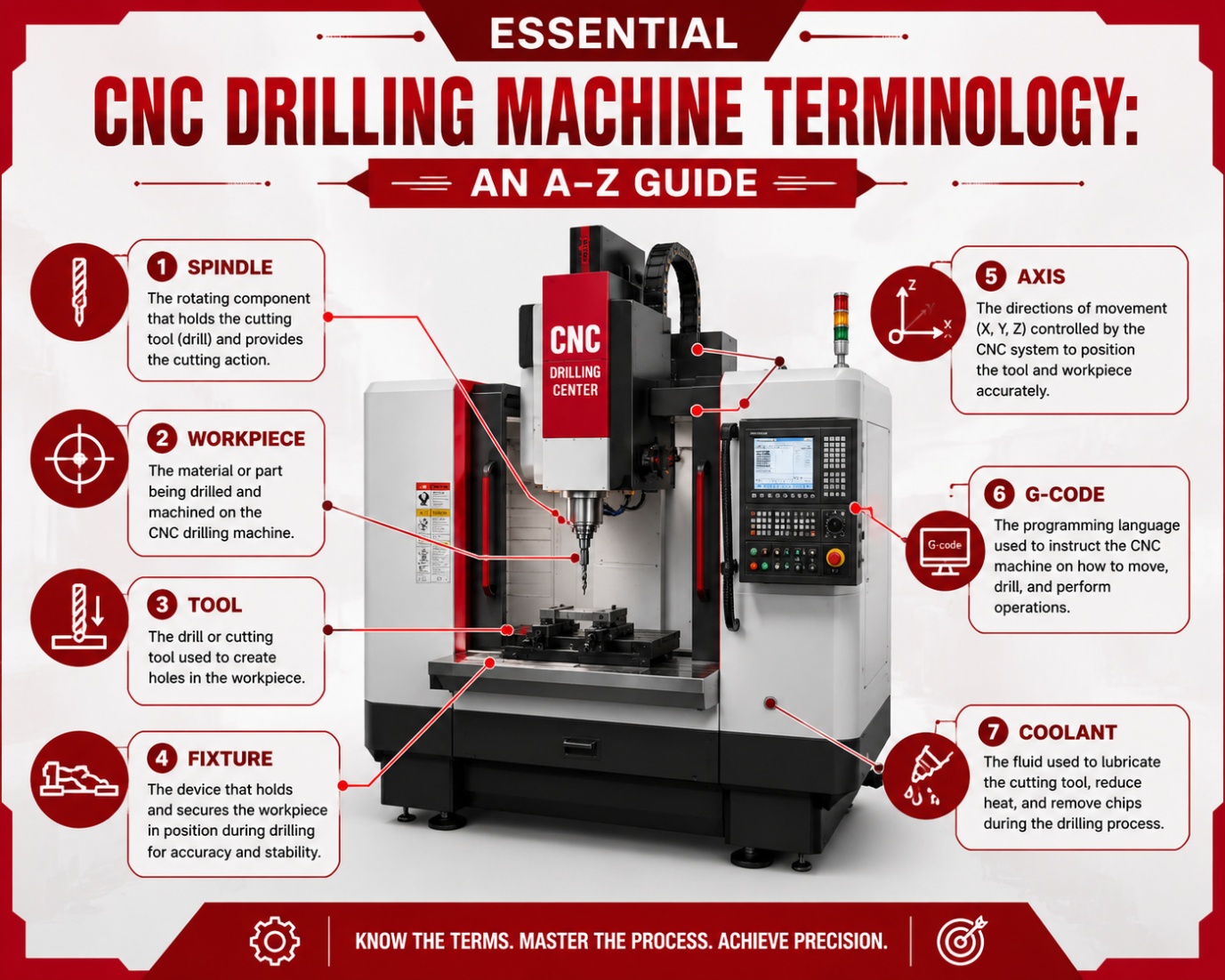
A CNC Drilling Machine is a type of machine that drills holes in metals, wood, plastics, and others at high speed and accuracy controlled by computers. CNC (Computer Numerical Control) works with computer programs instead of manually operation. It is perfect for repeatable drilling with less human error.
Yantra Design provides many types of CNC Machines like CNC Drilling Machine, CNC Plate Drilling Machine, CNC Tube Sheet Drilling Machine, CNC Fiber Laser Cutting Machine and so on. Such modern machines have applications in many industries such as Steel Structure Fabrications, Civil Engineering, Bridges manufacturing, Shipbuilding industry, Railway manufacturing, Automobile industries, Heavy engineering, power transmission tower manufacturing, Aerospace, industrial equipment manufacturing and the infrastructural industry.
By implementing CNC machines in industries it results in higher production efficiency, with accuracy maintained at high standards with decreased material wastage and rapid manufacturing processes, producing quality products at increased rates of manufacturing operations.
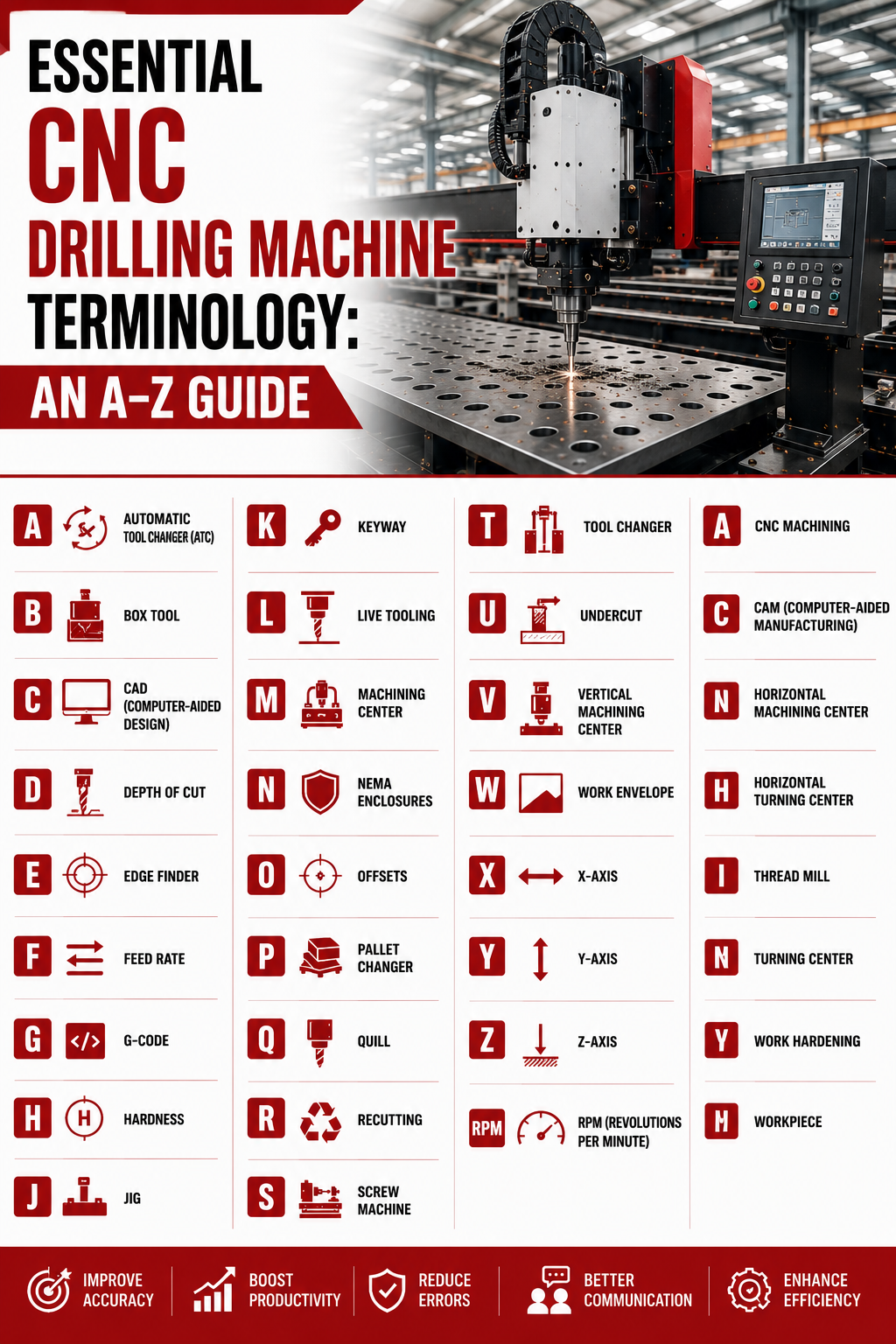
Nowadays manufacturing industries depend on the high precision, automatic and economical operation afforded by the CNC machining and drilling technologies. This operation clarity using familiar and widely adopted terms will let engineers, operators, machinists and manufacturers have the ability of effective communication with machines and the capacity to efficiently operate their machines, program the machine effectively, handle and maintain machine well and troubleshot it timely as well as produce high quality products. Most of commonly used terms in the CNC drilling and machining are listed and explained as an alphabetical guide.
Automatic Grinding Center
A type of CNC machining center used for automatically grinding and Sharpening cutting tools, inserts and machining parts.
Automatic Tool Changer (ATC)
An Automatic Tool Changer is a device or a mechanism that automatically exchanges cutting tools that are used in an automated machine tool for drilling, milling, turning etc., without human intervention. It enhances the rate of production and decreases idle time.
Axis
The direction which defines the movement capability of the machine is known as axis in CNC machining. In general, X, Y and Z axes are used by machines in the machining operation.
Box Tool
A Box tool is a holder, in which some tools are partly housed and that supports the job to hold them during machining in the automatic lathes and screw machines.
CAD (Computer-Aided Design)
CAD is software used for designing parts and products through computer by using drawings and designs which are required to manufacture components, before actually using them for manufacture.
CAM (Computer-Aided Manufacturing)
CAM is computer-based technology, that uses CAM software to create a set of instructions used to control the machining of a workpiece by using its CAD model, to prepare for the machining.
CNC Machining
CNC Machining is basically the machining and fabrication process, where, the machines are controlled by a computer; it is a technology where the machines are able to precisely cut, shape, mill, drill, turn and bore components as specified in the desired manufacturing plan.
Depth of Cut
The distance to which a tool is allowed to penetrate the workpiece at one time is defined as the depth of cut in machining operations.
Digitizer
A device or the process used to scan and capture the geometric shape of any physical part or feature from a real-life object and present it as a 3D model, that is the basis of using CAD/CAM systems.
Edge Finder
A tool used on milling machines, for precisely setting up the workpieces on to the machine table and to determine the work offset.
End Mill
The milling tools in CNC machining are known as end mill. These tools are used to cut the materials from the workpiece to achieve desired shape. They can have ball nose shape, double ended type etc.
Feed Rate
It is the rate in distance to which the cutting tool progresses through the workpiece while it is cutting it in a machining process.
G-Code
G-code is a set of instructions written using standard CNC language (also called as RS-274). G-codes command the machine's behavior such as movement speed and coordinates for movement.
Hardness
It refers to the ability of a material not to be scratched or indented, during its working during the machining process.
Horizontal Machining Center
These machines usually perform a multitude of machining operations; but utilize horizontally aligned spindle that controls milling.
Horizontal Turning Center
These are a type of lathe, with their spindle oriented horizontally. It is mainly employed for turning operation.
Inserts
The tip part of any cutting tool made of carbide, ceramic or diamond and inserted in an appropriate tool holder to form a cutting edge used in machining operation is called insert.
Jig
A fixture or apparatus that supports and guides a tool in performing a precise operation is called a jig and it used primarily in manual machining.
Live Tooling
In any machine, the power supplied to the tool itself for cutting operation other than turning operation; it is typically on a lathe machine turret to operate during its rotation. For instance, milling operations performed by using Live tooling on a turning center.
Machining Center
It is a CNC machine that is usually equipped with an Automatic Tool Changer (ATC) for performing drilling, boring, milling and tapping operations; thus a multi-operation tool of machining is called a machining center.
Milling
The process of using a rotating cutting tool in a machining operation where, the cutting tool advances into a workpiece as it rotates; thereby it carves away material from the workpiece to produce a desired shaped, that is called milling.
NEMA Enclosures
NEMA enclosures protect the electrical and electronic systems of CNC machinery from any environmental harm that could affect the electronics functioning. NEMA stands for National Electrical Manufacturers Association.
Offsets
Offsets help the CNC controller determine and provide accurate values of the exact position and length of the workpieces as well as tool position from a common base value while machining, thus it is very helpful in defining and positioning work pieces.
Pallet Changer
A tool/ work piece changing mechanism that, in order to reduce the loading and unloading time and maximize output, switches from one work piece pallet set up to another automatically in CNC machines; a process of improving efficiency.
Quill
A quill refers to the feature part on some CNC and other machine tools; especially in milling machines and drill presses, which moves the spindle into and out of the workpiece that controls the depth of the cut.
Recutting
When the metal cuttings generated during the machining process are not effectively removed from the workpiece and get embedded or stuck onto the cutting edge, it causes a re-cut on the workpiece, thereby results in poor surface finish and increases wear on tool. This phenomenon is called as recutting.
Resolution
The resolution defines the incremental amount that the position coordinates of a CNC machine or any of its component can be changed. It indicates the precision with which the motion of a machine part can be controlled.
Screw Machine
It is a type of automatic lathe which works with feeding bars of materials that are continuously being fed to it as the stock for parts which will then be screwed and manufactured using this feed.
Setup
The preparation activities, procedures and adjustments performed to get the CNC machine ready for a specific machining task or operation; these procedures include fixing the workpiece, setting up the cutting tool and establishing machine parameters.
Thread Mill
A specialized type of milling tool called a thread mill is employed for producing either an internal thread or external thread on a workpiece.
Tool Changer
A mechanism which stores multiple tools at various positions; allowing for an automated exchange to be made between them during the machining process thus increasing production time, as there is no need for manual tool change by operators.
Turning Center
A turning center is similar to a lathe in that it utilizes the process of turning. Here, instead of the cutting tool's spindle rotating the tool into stationary workpiece, it's the workpiece's spindle which rotates while the cutting tool moves to eliminate material to create cylindrical components.
Undercut
It is the recess formed behind a shoulder, the inner corner or behind the features of a workpiece and it's quite impossible for a simple cutting tool to form an undercut properly with straight cutting edge without special considerations.
Vertical Machining Center
These machines typically perform multiple operations and contain a variety of features but use a spindle that moves up and down on the vertical axis to do its milling operations.
Vertical Turning Center
These centers utilize the process of turning with the spindle vertically aligned. It is best suited for large workpieces with a central hole to hold them securely.
Work Envelope
It defines the entire machining area of any CNC machine up to where it can move to perform a machining operation.
Work Hardening
This is phenomenon, which occur in certain ductile metals when they undergo cold working that leads to their hardening as deformation. This is commonly observed when such metals undergo machining operation so this property affects work piece accuracy and finish.
Workpiece
Any material which is being drilled, cut or machined in any process is commonly referred to as a workpiece in machining industries.
X-Axis
It signifies horizontal movement to the left and right direction of a machine part in any given CNC machine or related equipment.
Y-Axis
It signifies vertical movement, perpendicular to the X axis in any any CNC machine or relevant machining component.
Z-Axis
It is the axial motion of any machining tool with respect to the part in depth, hence it describes the movement towards and away from the workpiece and in vertical machining centers; it is actually related to the moving of spindle either down toward or up away from the job.
Everyone in the manufacturing area would need to understand the terminology that comes with CNC machining and drilling processes. Through the understanding of terms, it would increase the flow of communication between machine operator, engineers and the manufacturers and thus improve both machine handling and production quality. CNC is a rapidly developing technology and learning common CNC machining terminology would enhance efficiency.
Join the ranks of satisfied clients who have experienced the difference of working with a leader in CNC drilling machine manufacturing.