
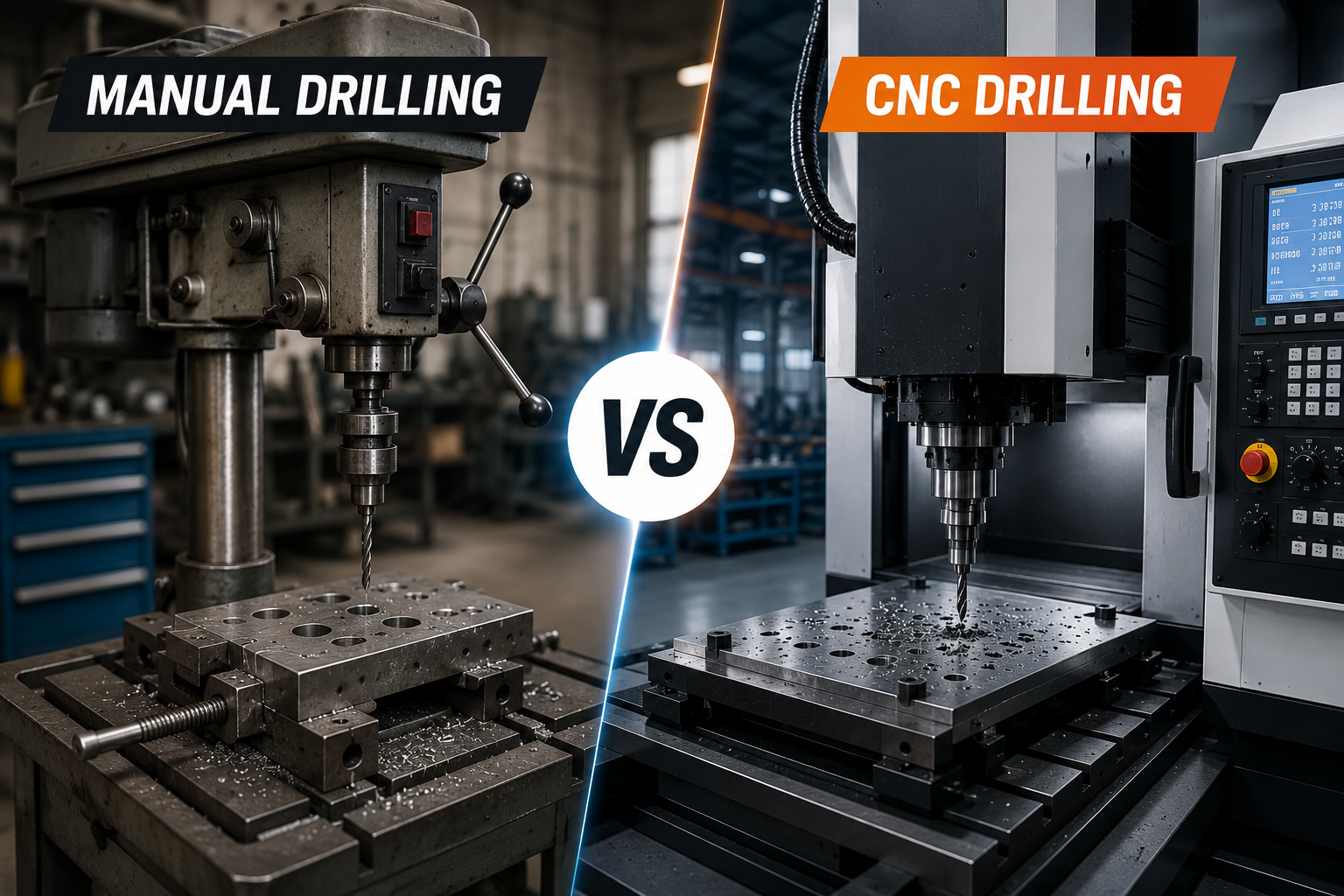
Choosing the right machining process is essential for maintaining manufacturing efficiency, reducing material waste, and ensuring high product quality. In the modern fabrication industry, the debate of Manual Drilling vs CNC Drilling is highly relevant for factory owners and production engineers alike. Understanding the unique strengths and limitations of both drilling methods will help you make the most profitable choice for your production floor.
A manual drilling machine is traditional equipment that relies entirely on human operation. The machinist must physically align the workpiece, securely clamp it, select the appropriate drill bit, and manually control the feed rate during the entire operation. While this hands-on method offers flexibility for simple, custom, or one-off jobs, its reliance on human skill makes it highly susceptible to errors, operator fatigue, and inconsistencies over long production runs.
Conversely, an automatic drilling machine operates using Computer Numerical Control (CNC). A CNC drilling machine follows precise, pre-programmed digital instructions to execute complex hole-making operations without active manual intervention. By entirely automating the spindle speed, feed rate, and tool positioning, CNC technology guarantees unparalleled precision drilling. This modern approach drastically reduces human error, making it the definitive industry standard for mass manufacturing and heavy steel fabrication.
When evaluating CNC vs manual drilling, it is crucial to compare them across several vital operational metrics.
| Feature | Manual Drilling Machine | CNC Drilling Machine |
|---|---|---|
| Accuracy | Varies based on operator skill | Extremely high, flawless tolerances |
| Speed | Slower cycle times, prone to fatigue | Lightning-fast, optimized cutting cycles |
| Productivity | Low, inefficient for large batches | High, perfect for mass production runs |
| Automation | Completely manual | High levels of manufacturing automation |
| Labor Requirements | Requires constant, highly skilled labor | One operator can monitor multiple machines |
| Repeatability | Low consistency across multiple parts | Perfect repeatability on every workpiece |
| Operating Costs | High ongoing labor and error costs | Higher upfront cost, low long-term costs |
| Safety | Higher risk of direct operator injury | Enclosed systems ensure high safety |
A manual setup is still suitable for small-scale fabrication workshops, local automotive repair garages, or maintenance departments handling low-volume repairs. If your daily operations require drilling basic holes in one-off workpieces where strict tolerances are not critical, a standard manual press provides a highly cost-effective, immediate solution with low upfront capital.
If your business handles structural steel manufacturing, heavy engineering, or high-volume part production, upgrading to an industrial drilling machine is non-negotiable. Specialized equipment like a CNC plate drilling machine or a CNC tube sheet drilling machine maximizes overall factory output, ensures strict dimensional accuracy, and dramatically shortens project lead times, allowing you to take on larger, more profitable contracts with complete confidence.
At Yantra Design, we understand the rigorous demands of modern heavy fabrication. We engineer premium CNC drilling solutions that deliver unmatched speed, robust durability, and extreme accuracy. Our custom-built machinery empowers ambitious businesses to transition seamlessly from manual processes to advanced automation. Backed by exceptional after-sales support and industry-leading build quality, Yantra Design is your trusted partner for sustainable industrial growth.
The ultimate choice between Manual Drilling vs CNC Drilling comes down to your production goals and volume requirements. While manual methods work well for simple, low-volume tasks, CNC machines provide the critical scalability and precision required to stay competitive today.
Ready to modernize your production line? Explore our high-performance CNC machinery and revolutionize your manufacturing capabilities today.