
In today's fast-paced manufacturing industry, milling machines are essential for cutting, shaping, drilling and machining a variety of materials with high precision. Milling technology has become an integral part of modern production, from automotive and aerospace parts to heavy industrial and custom metal fabrication. The CNC Milling Machine and Manual Milling Machine are the most common types of milling machines found in workshops and manufacturing facilities. Both machines are intended to perform similar machining operations, but they differ greatly in their working methods, efficiency and overall performance.
Choosing the right milling machine is vital to increase productivity, ensure accuracy and achieve cost-effective manufacturing. Which is best depends on things like production volume, budget and the complexity of machining work CNC milling machines are used more often for high-volume production and complex machining operations that call for more accuracy and repeatability, while manual milling machines are better suited for small jobs and simple functions. Knowing the difference between these two machines helps businesses make informed decisions and be more efficient in their operations.
Manual milling machines can be defined as traditional machines that are operated mechanically by a skilled machinist through manual means instead of utilizing any form of automated technology to control the machine. The machining operator uses handwheels, lever controls or any other form of mechanical control, to manually move the cutting tool and workpiece to achieve the final output and precision in the machining process relies heavily upon the operator's technical skill as well as their level of experience.
Manual milling machines can be seen in operation in maintenance applications, repair works and in producing prototype parts or carrying out any number of small scale machining works in which automatic process is not required. The majority of manual milling machines are used for:
The manual operation of a milling machine is highly dependent on the ability and skill of the machinist in producing machined parts with a high degree of accuracy.
CNC (Computer Numerical Control) milling is a form of machining that utilizes automated systems to control the operation of machine tools. The CNC milling process uses programming software to control the cutting tools' movements based on commands written in a programming language (commonly referred to as G-code). This programming allows the machine tool(s) to operate autonomously, making complex and precise cuts, drills, shapes, and mills with little or no input from an operator.
In various industries that require speed, precision and repeatability of parts, CNC Mill machines are very common CNC milling operations include faster production of parts across various components with high accuracy and repeatability. Some of the most common applications of CNC milling machines include:
The CNC milling machines are capable of producing highly accurate parts repeatedly while maintaining exceptional quality standards.
Operational Control System
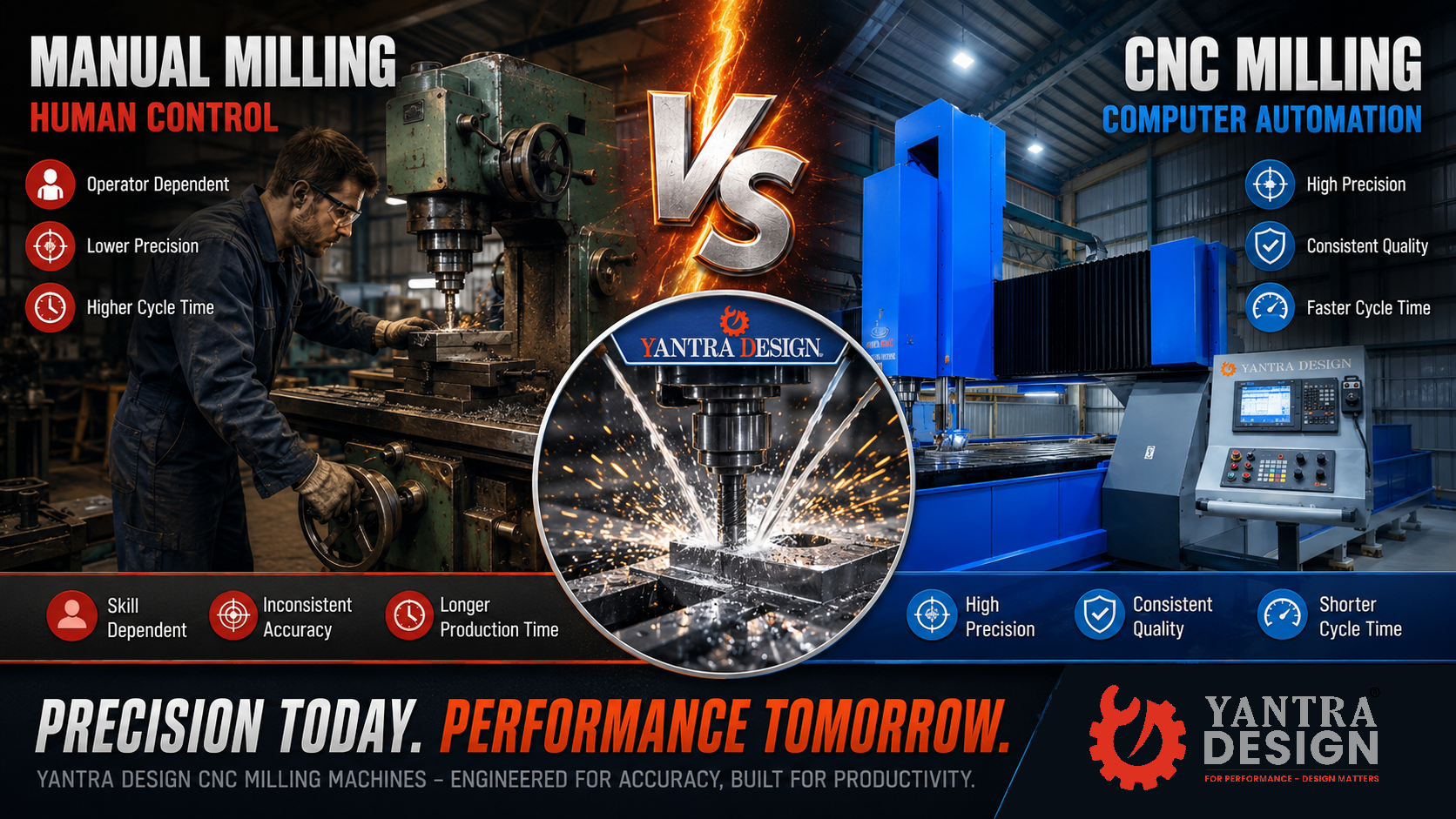
A manual milling machine requires direct operator control for every machining movement including feed adjustment, table positioning, cutting depth and spindle movement throughout the machining process. CNC milling machine operates through computerized programming systems that automatically control machining operations, cutting sequences, feed movement and spindle positioning with minimal manual intervention.
Machining Accuracy and Precision
The machining accuracy of manual milling machines depends heavily on the operator's technical skill, machine handling experience and ability to maintain operational consistency during production. CNC milling machines provide highly accurate machining performance through automated positioning systems, programmed tool paths and computer-controlled movements that ensure precise dimensional tolerances.
Production Speed and Manufacturing Efficiency
Manual milling operations are comparatively slower because every machining adjustment requires physical operator involvement and continuous monitoring during production activities. CNC milling machines significantly improve production speed through automated machining cycles, optimized cutting parameters and reduced operational downtime during repetitive manufacturing processes.
Production Consistency and Repeatability
Maintaining identical dimensions and surface quality across multiple components can be challenging because machining consistency depends entirely on operator control and manual handling precision. CNC milling machines provide exceptional repeatability by executing identical programmed instructions repeatedly, ensuring uniform quality and dimensional consistency throughout large production batches.
Complexity of Machining Capability
Manual milling is capable of most standard operations such as basic facing, slotting, drilling and simple contour milling. CNC milling machines can efficiently perform advanced machining operations including intricate contours, multi-axis machining, complex geometries and precision-engineered component manufacturing.
Labor Requirement and Operator Dependency
Manual milling machines require continuous operator involvement throughout machining operations including feed control, positioning adjustments, tooling alignment and dimensional measurement activities. CNC milling machines require operator involvement mainly during programming, setup and inspection stages while the automated system independently performs machining operations with minimal supervision.
Initial Investment and Operating Cost
Manual milling machine involves lower initial purchase costs, simpler maintenance requirements and reduced operational expenses making them suitable for smaller workshops and limited-budget manufacturing environments. CNC milling machines require higher capital investment due to advanced automation technology, precision components, software integration and specialized maintenance requirements associated with automated machining systems.
Surface Finish and Product Quality
Surface finish quality produced by manual milling machines may vary depending on operator expertise, feed consistency, machine stability and overall machining conditions during component manufacturing operations. CNC milling machines produce superior surface finishes through precise feed control, stable cutting conditions, automated tool movement and optimized machining parameters during high-precision manufacturing processes.
Industrial Application and Production Suitability
Manual milling machines are commonly used for repair work, prototype development, educational training, tool room operations and low-volume custom machining applications within smaller workshops. CNC milling machines are extensively utilized in aerospace, automotive, medical, defence, and precision engineering industries requiring high-volume production, automation and consistent machining accuracy standards.
CNC Milling Machines have become an essential part of modern industrial manufacturing due to their high precision, automation capability and production efficiency. Large industries that extensively use CNC milling machines include:
CNC Milling Machines have transformed modern manufacturing by delivering exceptional precision, automation and operational efficiency across multiple industries. Their ability to produce complex components with consistent quality makes them an indispensable part of advanced industrial production.
The selection between a CNC Milling Machine and a Manual Milling Machine depends entirely on production requirements, machining complexity, budget allocation and operational objectives.
A Manual Milling Machine is more suitable when:
A CNC Milling Machine is more suitable when:
At Yantra Design, CNC milling technology plays a crucial role in delivering precision-engineered machining solutions for diverse industrial applications. With advanced CNC milling capabilities and a commitment to manufacturing excellence, Yantra Design specializes in producing high-quality components that meet stringent dimensional and performance requirements. The company serves a wide range of industries including aerospace, automotive, heavy engineering, industrial machinery, steel fabrication and custom manufacturing.
By leveraging modern CNC milling machines, Yantra Design ensures superior accuracy, repeatability and production efficiency while maintaining the highest quality standards. Whether it involves prototype development, custom component manufacturing or large-scale production, Yantra Design combines technical expertise with advanced machining technology to deliver reliable and cost-effective solutions tailored to client requirements. Its focus on precision engineering and continuous innovation makes Yantra Design a trusted partner for businesses seeking high-performance CNC machining services.
Both CNC Milling Machines and Manual Milling Machines play essential roles in modern manufacturing and industrial machining operations. Manual milling machines remain valuable for small-scale production, repair work and customized machining applications due to their affordability and operational flexibility. However, CNC milling machines have become the preferred choice for advanced industrial manufacturing because of their superior accuracy, automation capability, production efficiency and consistency.
As manufacturing industries continue adopting automated production technologies, CNC machining systems are increasingly driving productivity, precision and operational performance across multiple industrial sectors. Companies such as Yantra Design contribute to this industrial transformation by delivering advanced CNC machining, drilling and metal processing solutions that help manufacturers improve operational efficiency and achieve high-quality production standards. Through its focus on precision engineering and innovative manufacturing technologies, Yantra Design supports the evolving needs of modern industries across multiple sectors.
Ultimately, the choice between a CNC Milling Machine and a Manual Milling Machine should be based on production requirements, machining complexity, budget considerations and long-term business objectives.
Join the ranks of satisfied clients who have experienced the difference of working with a leader in CNC drilling machine manufacturing.