
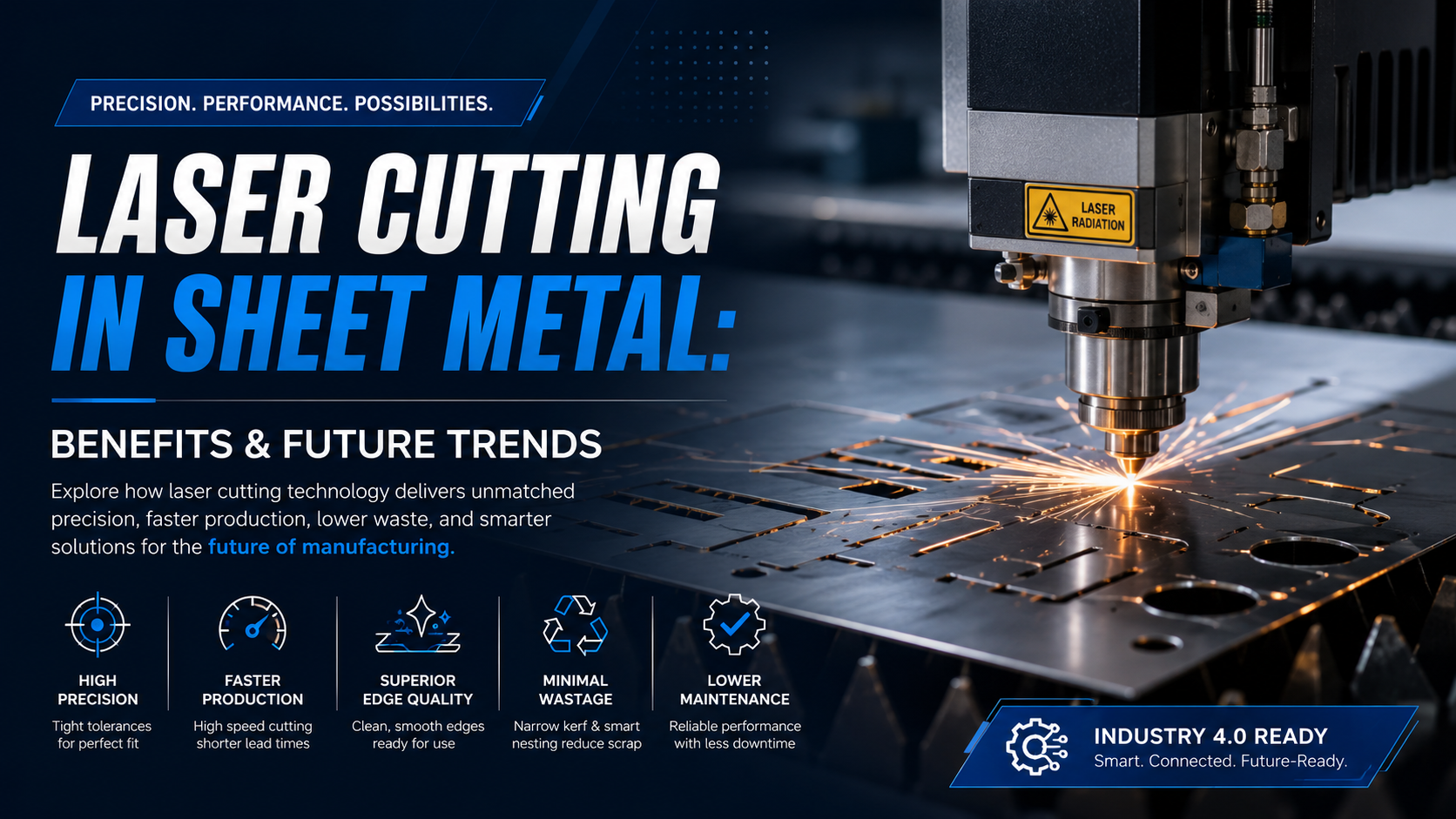
Modern sheet metal manufacturing runs on precision. A part that is off by even a fraction of a millimeter can fail to fit, weaken a weld, or stall an entire assembly line. This is why laser cutting technology has become the backbone of competitive fabrication shops across India and the world.
Laser cutting uses a focused, high-energy beam to slice through metal with accuracy that traditional tools struggle to match. It produces clean edges, tight tolerances, and complex shapes without physical contact, so there is no tool wear and no part distortion from cutting pressure. For manufacturers, fabricators, and procurement teams, that translates into less rework, lower scrap, and faster delivery.
As demand grows for lighter, stronger, and more intricate metal components, the businesses that adopt advanced cutting methods gain a clear edge. This guide explains how laser cutting works, where it is used, how it compares with older methods, and where the technology is heading. Whether you run a fabrication unit or evaluate machines for a factory, understanding laser cutting will help you make smarter, more profitable decisions.
Laser cutting is a thermal cutting process that uses a concentrated beam of light to melt, burn, or vaporise material along a programmed path. The word LASER stands for Light Amplification by Stimulated Emission of Radiation. In sheet metal processing, this beam is focused to a tiny spot, generating intense heat that cuts through metal cleanly and precisely.
The process follows a simple but powerful sequence:
Because the cutting head never touches the workpiece, there is no mechanical force on the part. The width of the cut, called the kerf, is extremely narrow, which is one reason laser cutting is so accurate.
Two main types dominate metal cutting:
A third category, crystal lasers (Nd:YAG / Nd:YVO4), exists for specialized high-power applications, but fiber and CO2 machines cover the vast majority of industrial sheet metal needs.
Laser cutting has changed how fabrication shops handle raw sheets. Its role goes far beyond simply making cuts.
CNC laser machines hold tolerances as tight as ±0.05 mm to ±0.1 mm on typical sheet thicknesses. This level of repeatable accuracy means parts fit together correctly the first time, reducing assembly issues and rework.
Smart nesting software arranges multiple parts on a single sheet to use the maximum possible area. A good nesting layout can lift material utilization well above what manual layout achieves, directly lowering raw material cost per part.
Because the kerf is narrow and parts can be packed tightly, the amount of leftover scrap drops sharply. For shops cutting expensive grades like stainless steel, even a small reduction in waste adds up to significant savings over a year.
A single CNC laser machine can run continuously, switching between different part designs by simply loading a new program. There is no need to change physical tooling for each shape, so the machine spends more time cutting and less time being set up.
Below are the key benefits that make laser cutting a strong investment for manufacturers.
Laser cutting serves almost every sector that works with metal. Here is how different industries use it.
To choose the right method, it helps to compare laser cutting with plasma, mechanical, and waterjet cutting.
| Factor | Fiber Laser Cutting | Plasma Cutting | Mechanical Cutting | Waterjet Cutting |
|---|---|---|---|---|
| Accuracy | Very high (±0.05–0.1 mm) | Moderate | Low to moderate | High |
| Speed | Very fast on thin–medium sheet | Fast on thick plate | Fast for simple cuts | Slow |
| Operating Cost | Low (energy efficient) | Low to moderate | Low | High (abrasive + water) |
| Maintenance | Low | Moderate | Moderate (tool wear) | High |
| Material Compatibility | Most metals, incl. reflective | Conductive metals only | Limited shapes | Almost any material |
For most sheet metal fabrication, fiber laser cutting offers the best balance of precision, speed, cost, and edge quality.
The "CNC" in CNC laser cutting stands for Computer Numerical Control, and it is the brain that turns a powerful laser into a productive manufacturing tool.
Yantra Design provides advanced CNC laser cutting solutions built for precise, high-volume sheet metal processing, helping fabrication businesses raise output while maintaining tight quality control.
Laser cutting continues to evolve rapidly. Here are the developments shaping its future.
Buying a laser machine is a major investment. Weigh these factors carefully before deciding.
Choosing the right machine partner is as important as choosing the right machine. Yantra Design stands out for several reasons.
Laser cutting technology has reshaped sheet metal processing by delivering precision, speed, and efficiency that traditional methods cannot match. From cutting clean, complex shapes to reducing waste and labour, it gives manufacturers a real competitive advantage. Fiber lasers in particular have made the technology more energy efficient, more versatile across metals, and easier to maintain, which is why they now lead the industry.
As manufacturing moves deeper into Industry 4.0, with AI, IoT, automation, and predictive maintenance becoming standard, laser cutting will only grow more capable and more central to modern production. Businesses that invest now position themselves for higher output, better quality, and stronger margins for years to come.
Choosing the right CNC laser cutting machine, however, depends on your materials, volume, and long-term goals. The right partner makes that decision easier and protects your investment with quality engineering and dependable support. If you are ready to upgrade your fabrication capabilities, Yantra Design offers advanced CNC laser cutting solutions tailored to precise sheet metal processing. Reach out to discuss the machine best suited to your needs.
Join the ranks of satisfied clients who have experienced the difference of working with a leader in CNC drilling machine manufacturing.