Vertical vs Horizontal CNC Milling Machines: Pros and Cons

Vertical vs Horizontal CNC Milling Machines: A Complete Comparison Guide

Vertical vs Horizontal CNC Milling Machines: Pros and Cons

CNC machining is the backbone of precision manufacturing. From engine parts to machine housings, most metal components pass through a milling machine at some stage. The machine you choose has a direct effect on accuracy, speed, and cost.

When buyers shortlist a CNC milling machine, one question comes up again and again: should it be vertical or horizontal? Both cut metal with great accuracy. But they are built differently, behave differently, and suit different kinds of work.

Picking the wrong one is an expensive mistake. A vertical machine bought for high-volume, heavy production may struggle to keep up. A horizontal machine bought for occasional, simple jobs may sit idle and tie up capital.

This guide breaks down both types in an easy way. We will explain how each works, list the real pros and cons, compare them side by side, and show which industries use them. By the end, you will know which configuration fits your shop — and how it connects to the wider CNC machining setup that drives modern manufacturing.

What is a CNC Milling Machine?

A CNC milling machine removes material from a solid workpiece using a rotating cutting tool. "CNC" stands for Computer Numerical Control, which means a computer program guides the tool along precise paths to create the final shape.

The key difference between the two main types is the orientation of the spindle — the part that holds and spins the cutting tool.

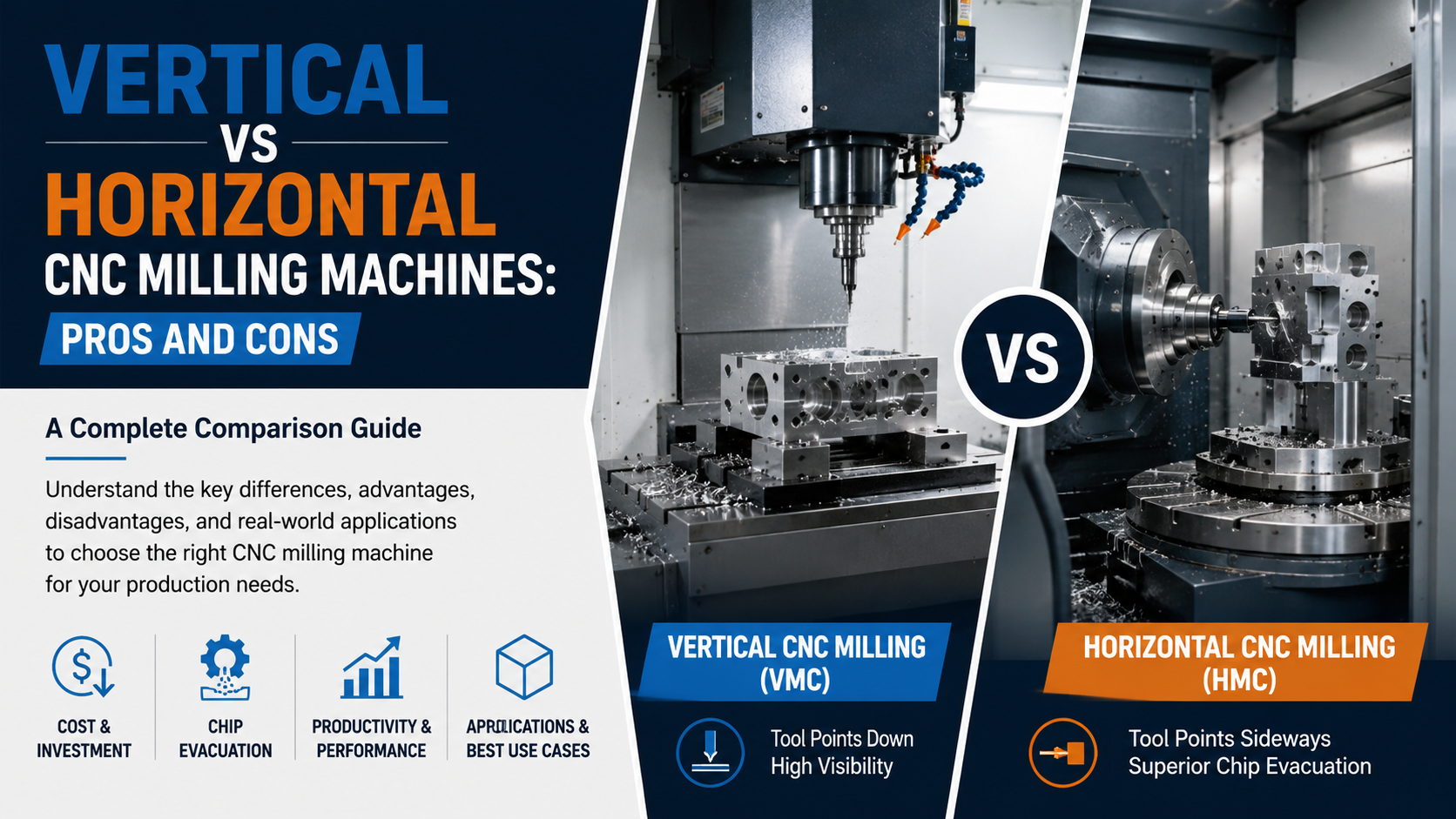
  • In a vertical CNC milling machine, the spindle is upright, so the tool points down toward the table. These are often called Vertical Machining Centers (VMCs).
  • In a horizontal CNC milling machine, the spindle lies flat, so the tool points sideways at the workpiece. These are called Horizontal Machining Centers (HMCs).

This single design choice changes almost everything: how chips fall away, how parts are held, how many sides can be cut, and how much the machine costs.

What is a Vertical CNC Milling Machine?

A vertical machining center has its spindle mounted vertically above the worktable. The operator can usually see the cutting tool and the workpiece clearly, which makes setup and inspection easy.

VMCs are the most common type of milling machine in workshops worldwide. They are popular with job shops, prototype makers, and small to medium manufacturers.

Pros of Vertical CNC Milling Machines

  • Lower cost: VMCs are cheaper to buy, install, and run, making them ideal for smaller budgets.
  • Easy setup and operation: The open, visible work area makes loading, clamping, and checking parts simple.
  • Great for flat and single-side parts: They excel at plates, molds, dies, and parts that need machining mainly from the top.
  • Smaller footprint: They take up less floor space than most horizontal machines.
  • Wide availability: Operators, tooling, and spares are easy to find.

Cons of Vertical CNC Milling Machines

  • Poor chip evacuation: Chips tend to pile on the workpiece and table, which can affect finish and tool life on heavy jobs.
  • Lower productivity for big runs: Most VMCs machine one face at a time and need more manual reloading.
  • Limited for complex multi-side parts: Reaching several sides often means re-clamping the part, adding setup time and the risk of small errors.

What is a Horizontal CNC Milling Machine?

A horizontal machining center has its spindle mounted sideways. The tool cuts the workpiece from the side, and chips fall away naturally with gravity instead of collecting on the part.

HMCs are built for serious production. They often include rotary tables and automatic pallet changers, letting them machine several faces of a part — and switch parts — with little downtime.

Pros of Horizontal CNC Milling Machines

  • Excellent chip evacuation: Chips fall straight down and clear out, giving cleaner cuts, better finish, and longer tool life on heavy material removal.
  • High productivity: Pallet changers let one part be machined while the next is loaded, keeping the spindle cutting almost non-stop.
  • Multi-side machining: A rotary table can present several faces of a part in one setup, reducing handling and improving accuracy.
  • Ideal for large, heavy, high-volume parts: Strong, rigid construction handles tough, continuous production.

Cons of Horizontal CNC Milling Machines

  • Higher cost: HMCs cost significantly more to buy and maintain.
  • Larger footprint: They need more floor space and a stronger foundation.
  • More complex setup: Programming and fixturing are more involved, requiring skilled operators.
  • Less visibility: The enclosed, sideways work area makes the cut harder to watch during operation.

Vertical vs Horizontal CNC Milling: Detailed Comparison

The table below sums up the practical differences that matter most when choosing.

Factor Vertical CNC Milling (VMC) Horizontal CNC Milling (HMC)
Spindle OrientationVertical (tool points down)Horizontal (tool points sideways)
Initial CostLowerHigher
Chip EvacuationPoorer (chips collect)Excellent (chips fall away)
ProductivityGood for low–medium volumeHigh for medium–large volume
Multi-Side MachiningLimited (needs re-clamping)Strong (rotary table, one setup)
Setup & OperationSimple, easy to learnMore complex, needs skill
Floor SpaceCompactLarge
Best ForFlat parts, molds, prototypes, job shopsHeavy, complex, high-volume parts
VisibilityHigh (open work area)Lower (enclosed)

In short: VMCs win on cost, simplicity, and flexibility for varied small jobs. HMCs win on speed, finish, and output for large, repetitive production.

How to Choose Between Vertical and Horizontal Milling

There is no single "best" machine — only the best fit for your work. Weigh these factors before deciding.

  • Part Complexity: Simple, flat parts suit a VMC. Parts needing several machined faces favour an HMC.
  • Production Volume: Low to medium volume points to a VMC. High, repetitive volume points to an HMC.
  • Budget: VMCs cost less up front and are easier to justify for smaller shops.
  • Chip Control: Heavy material removal jobs benefit from the natural chip clearing of an HMC.
  • Floor Space: Tight shops favour the compact VMC; HMCs need more room and a solid base.
  • Accuracy and Setups: Fewer setups mean fewer errors. If a part needs many sides machined, an HMC's single-setup ability protects accuracy.
  • Skill and Support: Make sure you have operators who can run the machine and a supplier who provides reliable training and after-sales service.

Why Choose Yantra Design for Your CNC Machine Needs?

Yantra Design is a manufacturer and supplier of CNC drilling machines built for Indian manufacturing and engineering industries. While this guide compares milling configurations, the same principles — precision, productivity, and reliable support — guide every machine we build.

  • Advanced Technology: Modern CNC solutions, including CNC laser cutting machines, CNC drilling machines, and CNC plate drilling machines.
  • Precision Engineering: Machines designed to hold tight tolerances and deliver consistent, repeatable results.
  • Reliable Performance: Built for demanding production environments where uptime matters.
  • Custom Solutions: Equipment matched to your materials, volumes, and workflow.
  • After-Sales Support: Dependable technical help for installation, operation, and maintenance.
  • Made for Indian Industry: Solutions designed with the needs and conditions of Indian fabrication and engineering shops in mind.

If your production line involves cutting and drilling alongside machining, our team can help you plan a setup where every step works together smoothly.

Conclusion

Choosing between a vertical and horizontal CNC milling machine comes down to your parts, your volume, and your budget. Vertical machining centers offer lower cost, easy setup, and flexibility for varied or smaller jobs. Horizontal machining centers deliver higher productivity, better chip control, and strong multi-side machining for large, repetitive production.

Neither is better in every case. The smart approach is to match the machine to your real workload, and to plan your milling alongside your cutting and drilling processes so the whole line runs efficiently.

As manufacturing moves toward automation and Industry 4.0, the gap between these machines is also narrowing, with smarter controls and better connectivity on both types. Whatever your direction, the right equipment partner makes the decision easier.

If you are planning or upgrading your CNC setup, Yantra Design can help you choose precise, reliable machines for cutting, drilling, and plate processing. Reach out to discuss the solution best suited to your production needs.

FAQs
Why are horizontal CNC milling machines more expensive?
HMCs cost more because they are built more rigidly and often include rotary tables and automatic pallet changers for higher productivity. They also need more floor space and skilled operators.
What is a VMC and an HMC?
VMC stands for Vertical Machining Center and HMC stands for Horizontal Machining Center. They describe the two main spindle orientations used in CNC milling.
Which industries use CNC milling machines?
Automotive, aerospace, electrical panel manufacturing, construction, agricultural machinery, and heavy engineering all use CNC milling for precise metal parts.
Are horizontal machines better for high-volume production?
Yes. Horizontal machines with pallet changers can keep cutting while the next part is loaded, making them well suited to continuous, high-volume work.
Why is chip evacuation better on horizontal machines?
Because the spindle is sideways, chips fall away from the workpiece with gravity instead of collecting on it. This improves surface finish and extends tool life on heavy jobs.
Can a vertical milling machine handle complex parts?
It can, but parts needing several machined faces often require re-clamping, which adds setup time and the risk of small errors. Horizontal machines handle multi-side parts more easily.
CNC Drilling Machine